
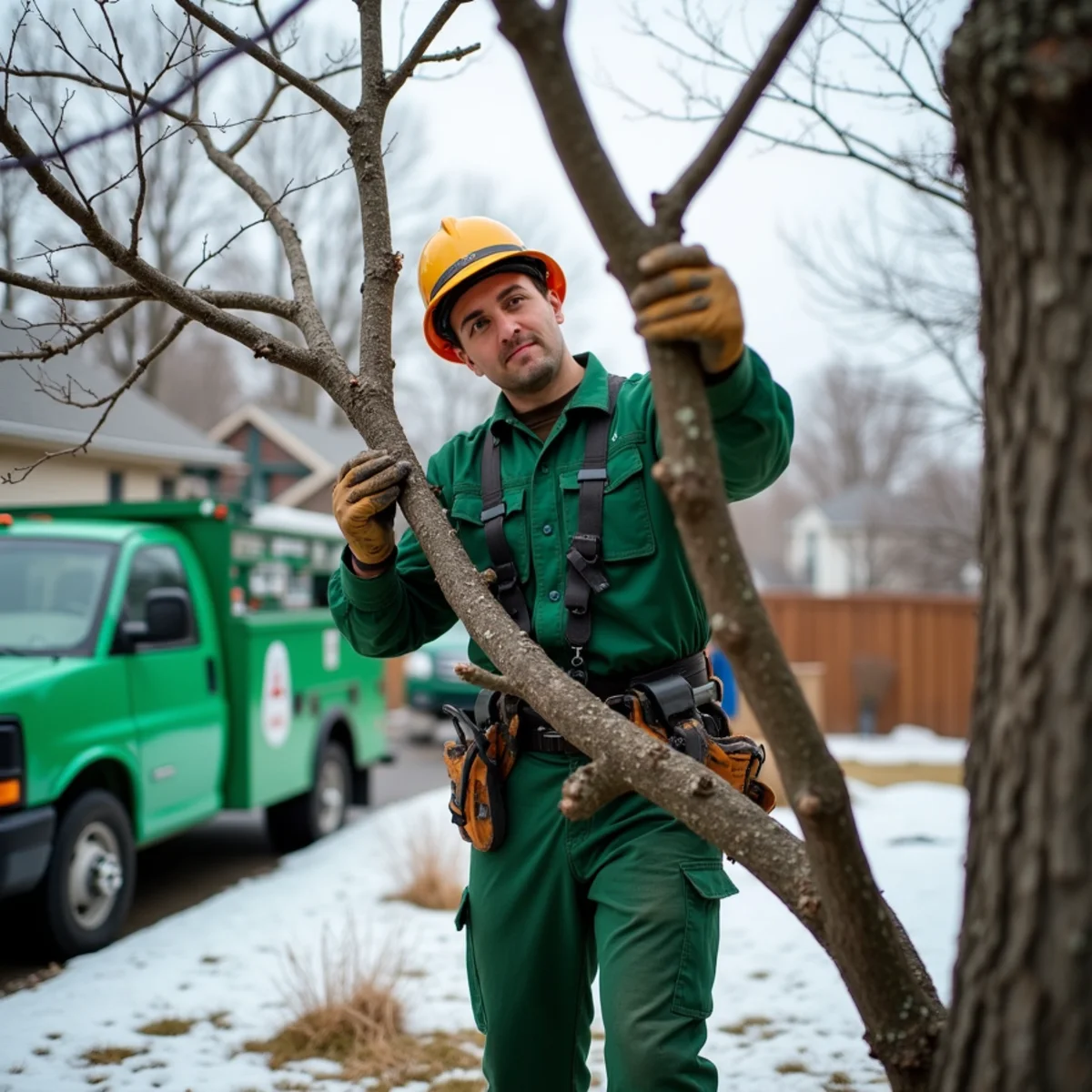
For most trees, the best time to trim trees in Indiana is late winter, roughly January through early March, while the tree is dormant and before new growth starts. Shrubs are different: spring-flowering shrubs like lilac and forsythia should be pruned right after they bloom, while summer-flowering shrubs get cut back in late winter. Oaks have a hard rule of their own because of oak wilt.
Timing matters because a cut at the wrong time can cost you a year of flowers, invite disease, or push out tender growth that winter kills. Below is how the seasons line up in Fort Wayne, species by species, followed by a month-by-month calendar you can keep on the fridge.
Why Late Winter Is the Best Time to Trim Trees in Indiana
Dormant-season pruning has real advantages in northeast Indiana. With the leaves off, you can see the tree's structure clearly, so crossing limbs, weak forks, and dead branches stand out. Most disease-carrying insects and fungi are inactive in the cold. And a tree pruned just before spring starts sealing its wounds as soon as growth begins.
There's a practical bonus too. Frozen ground holds up equipment better than soft spring clay, so there's less rutting in your lawn. It's also when much of our tree trimming and pruning on shade trees happens, because scheduling is usually more flexible than in the spring rush.
Aim for the back half of winter rather than right before a deep cold snap. A stretch of mild, dry days in February is close to ideal.
Oaks: Hands Off From April 15 to July 15
Oak wilt is a fungal disease that can kill a red or black oak in a single season, and it spreads partly through sap beetles drawn to fresh pruning wounds. According to Purdue Extension, the high-risk period for pruning oaks is April 15 to July 15, and the safest window for red and black oaks is December 1 through the end of February. Many homeowners and tree crews simply avoid pruning oaks for the entire growing season.
If an oak limb breaks in a storm or becomes a hazard in summer, it still has to be dealt with. In that case, Purdue's guidance is to treat the wounds immediately rather than leave fresh cuts open. Routine oak pruning, though, belongs in winter.
Maples, Birches, and the Sap Question
Maples, birches, and a few other species bleed sap heavily when they're cut in late winter as the sap starts rising. It looks alarming, but on a healthy tree the bleeding is mostly cosmetic.
If the dripping bothers you, there are two easy alternatives: prune earlier in the winter, around December or January, before sap flow begins, or wait until summer after the leaves have fully expanded and hardened off. For large, established trees, our guide to pruning mature maples goes deeper on how much to take and where to cut.
Flowering Shrubs: Follow the Bloom
The simplest rule for flowering shrubs is this: if it flowers in spring, prune right after it blooms; if it flowers in summer, prune in late winter. Get it backward and you cut off next year's flower buds.
Spring Bloomers: Prune Right After Flowering
Lilac, forsythia, azalea, rhododendron, and spring-blooming spireas set next year's flower buds over the summer. Prune them within a few weeks after the flowers fade, typically late April through early June in Fort Wayne depending on the shrub. Prune them in fall or winter and you'll get a nicely shaped shrub with few or no flowers.
Summer Bloomers: Prune in Late Winter
Panicle hydrangea, smooth hydrangea such as the common Annabelle type, summer-blooming spireas, and rose of Sharon all flower on growth made the same year. Cut them back in late winter or very early spring, before new growth starts, and they'll bloom on fresh stems that summer.
Bigleaf hydrangeas, the blue and pink mopheads, are the exception that trips people up. Most bloom on old wood, so limit spring pruning to removing dead stems and do any shaping right after flowering.
Rather not track the calendar yourself? We'll walk the property, flag what needs attention now and what should wait for winter, and give you a straight price. Call (323) 606-0255 for a free estimate.
Evergreens and Hedges
Yews, boxwood, arborvitae, and other evergreen shrubs do best with light shaping in late spring to early summer, after the first flush of new growth. A second light trim on fast-growing hedges is fine into early summer.
Avoid shearing evergreens in late summer and fall. Cutting then triggers tender new growth that doesn't have time to harden before frost, and it gets burned back over the winter. In Fort Wayne, a good working rule is to finish evergreen shearing by about mid-August.
- Keep hedges slightly wider at the bottom than the top so sunlight reaches the lower branches.
- Arborvitae and juniper rarely regrow from bare, older wood, so never cut back past the green foliage.
- Yews tolerate harder renewal pruning than most evergreens; do that kind of cutting in late winter.
- Pines are shaped by pinching the new candles back by about half in late spring, not by cutting into old wood.
Pruning That Can't Wait
Some work ignores the calendar entirely.
- Dead and hazardous limbs can come off any time of year. Deadwood doesn't carry the disease risk that live cuts do, and a dead limb over the driveway shouldn't wait for February.
- Storm-damaged limbs should be handled right away, especially broken or hanging branches over a house, walkway, or play area. A clean cut also heals better than a torn stub.
- Branches near power lines are AEP's line-clearance work. Call AEP rather than trimming near energized lines yourself.
- City street trees in the strip between the sidewalk and curb belong to the City of Fort Wayne, and pruning one requires City approval. Start with a call to 311.
A Month-by-Month Pruning Calendar for Fort Wayne
- January: Prime dormant pruning for most shade trees, including oaks. A good month for structural work on maples and birches before the sap rises.
- February: Finish oak pruning by the end of the month. Prune fruit trees, summer-blooming shrubs, and overgrown yews that need hard renewal.
- March: Last call for dormant pruning before buds break. Cut back panicle and smooth hydrangeas and rose of Sharon. Expect maples and birches to bleed if cut now.
- April: No oak pruning from April 15 on. Prune forsythia as soon as it finishes blooming, and clean up winter-burned tips on evergreens.
- May: Prune lilacs, azaleas, rhododendrons, and spring spireas right after bloom. Pinch pine candles late in the month.
- June: First shaping of yews, boxwood, arborvitae, and hedges once the new growth has flushed. Wrap up spring-blooming shrubs early in the month.
- July: Light summer pruning of maples and birches after the leaves harden, if you'd rather avoid bleeding. Oaks stay off-limits through July 15. Second light trim on fast hedges.
- August: Finish evergreen and hedge shearing by mid-month. Remove deadwood, which is easy to spot against green leaves.
- September: Skip heavy pruning while trees store energy for winter. Deadwood and hazard limbs only.
- October: Same as September. Wounds close slowly heading into winter and decay fungi are active, so fall is for planting and leaf cleanup, not shaping.
- November: Hold off until trees are fully dormant. Walk the yard, note what needs work, and get on a crew's winter schedule.
- December: The safest window for oaks opens December 1, and maples and birches can be pruned before the sap starts moving.
Mistakes That Cost You a Season, or a Tree
- Topping trees. Cutting big limbs back to stubs to shrink a tree causes weak, fast regrowth and decay. If a tree has outgrown its space, the answer is proper crown reduction or removal, never topping.
- Taking too much at once. As a rule of thumb, avoid removing more than about a quarter of a mature tree's live canopy in a single year.
- Flush cuts and stubs. Cut just outside the branch collar, the slight swelling where a branch meets the trunk. Flush cuts and long stubs both invite decay.
- Shearing flowering shrubs into balls. Repeated shearing removes flower buds and leaves a dense outer shell. Thin a few of the oldest stems at the base instead.
- Piling mulch on afterward. If you freshen beds after pruning, keep mulch 2 to 3 inches deep and pulled a few inches off trunks. Our mulching and bed maintenance visits follow that rule, because mulch volcanoes rot bark.
Since most large-tree pruning belongs in winter, fall is the time to get on the schedule. We prune shade trees, ornamentals, and shrubs across Fort Wayne and Aboite, and you can see what drives pricing in our tree trimming cost guide. For removals, stump grinding, and storm work, see our full tree service lineup. Call (323) 606-0255 for a free estimate.
Need a hand with this?
Tree & Shrub Trimming in Fort Wayne & Northeast Indiana
If you'd rather have it handled, our family-owned crew does this work every week. Estimates are free and written out.
Frequently Asked Questions
Is it bad to trim trees in the fall?
Can I trim an oak tree in the summer?
When should I cut back hydrangeas in Fort Wayne?
How often should trees be pruned?
Do I need permission to trim the tree between my sidewalk and the street?
All About Tree & Turf Services
Family-owned landscaping and tree service in Fort Wayne, led by Darick Van. We share what we've learned working on real Northeast Indiana properties. Questions? Call (323) 606-0255.