
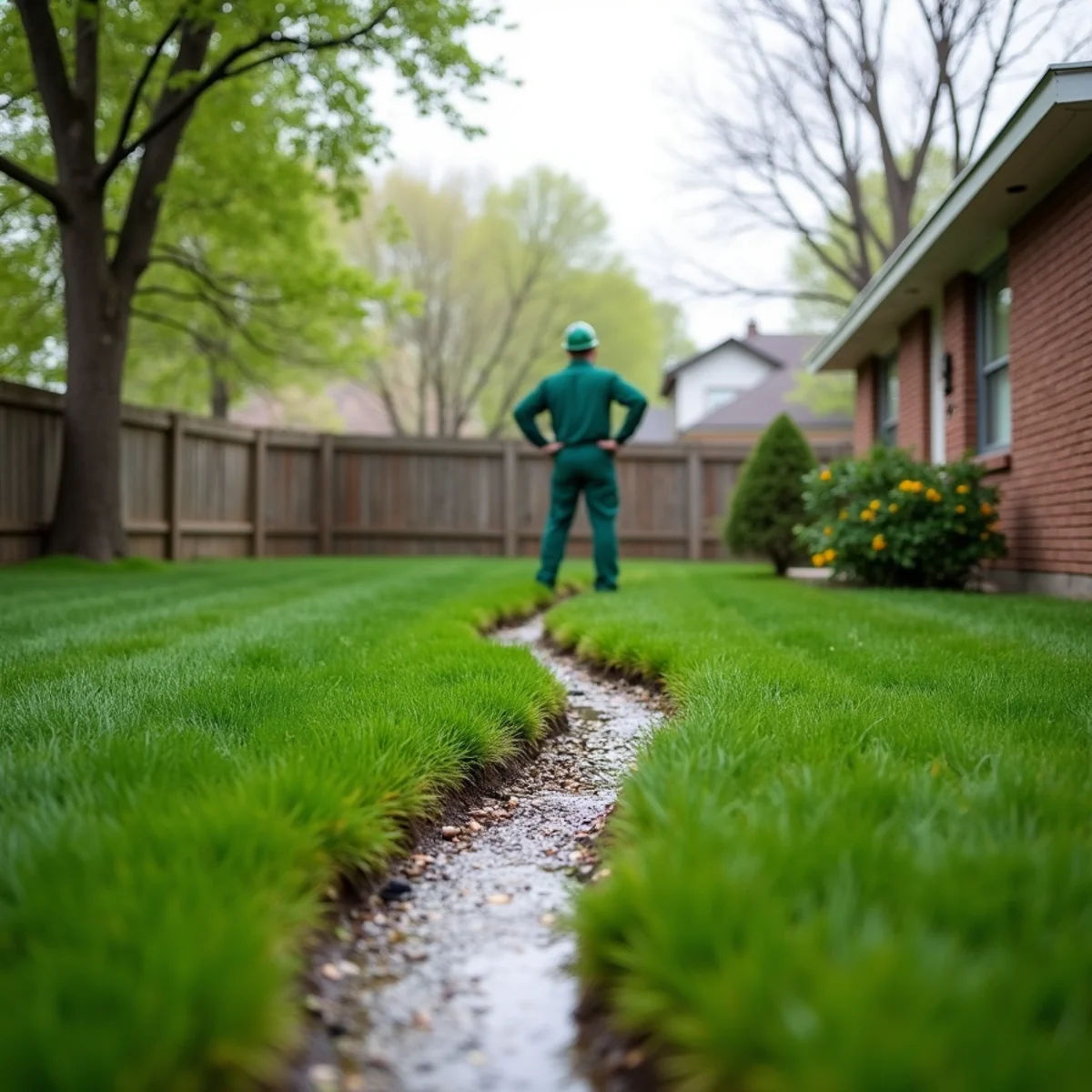
For most soggy yards around Fort Wayne, start with the cheapest fixes: extend the downspouts and correct any grade that tips water toward the house. If water still collects, a swale moves surface water when you have slope and room, and a French drain handles water soaking through the soil when there's a lower outlet to send it to. That's the short answer to French drain vs dry well vs swale: on heavy clay, the French drain usually beats the dry well, because a dry well only works if the ground around it can soak water in.
Much of Allen County sits on Blount and Pewamo clay, which takes in water slowly, and that one fact shapes every option below. Here's what each fix does, where each struggles on clay, and what to check before anyone digs.
What Each Drainage Fix Actually Does
These three get lumped together, but they solve different problems. Matching the fix to where your water comes from matters more than the fix itself.
- French drain: A fabric-lined trench of washed stone around a perforated pipe. It collects water moving through the soil and carries it downhill to an outlet. Its hard requirement is somewhere lower for the water to go.
- Dry well: An underground pit of stone or a plastic chamber that receives water from a downspout or drain line and holds it while it soaks into the surrounding soil. Its hard requirement is soil that actually absorbs water.
- Swale: A shallow, broad, grassed channel that steers surface runoff along a chosen path. You mow right over it. Its hard requirements are steady fall and enough room to shape it gently.
- Downspout extensions and regrading: Not glamorous, but often the actual fix. They stop roof water from dumping next to the foundation and make the ground slope away from the house.
Start With the Cheaper Fixes: Downspouts and Grade
Before you price a trench, walk your yard during a steady rain. A surprising number of wet spots trace back to one or two downspouts emptying a whole roof's worth of water onto the same few square feet, or to a strip of soil beside the house that has settled and now slopes inward.
Extending a downspout, with a simple above-ground extension or a buried solid pipe that discharges well away from the foundation, costs a fraction of any drain system. Regrading reshapes the soil so the first several feet around the house fall away from it, and so low spots in the lawn have a surface path out. As a rough planning range, not a quote, grading and prep work runs about $0.47 per square foot; the real number depends on how much soil has to move and whether topsoil has to be brought in.
A few things you can check yourself before calling anyone:
- Where does each downspout discharge, and is that the spot that stays wet longest?
- Does the soil near the foundation slope toward the house or away from it?
- Is the water coming from your own lot, or from higher ground next door?
- How long does the wet spot last after rain: hours, days, or until July?
- Is the soggy area at the lowest point of the yard, or partway up a slope?
French Drain vs. Dry Well on Blount and Pewamo Clay
This is where Allen County's soil decides the matchup. The two systems handle water in opposite ways, and clay favors one of them.
French Drains: Reliable If You Have an Outlet
A French drain doesn't need the soil to absorb anything. It gives water an easier path than the clay and carries it away by gravity, which is why it holds up on heavy ground. Good French drain installation uses fabric to keep clay fines out of the stone, a steady downhill slope with no dips, solid pipe on the run to the outlet, and a cleanout for flushing the line.
The catch is the outlet. The pipe has to end somewhere lower than the wet area, such as daylight on a lower part of your property, a pop-up emitter in the lawn, or a swale. On flat lots that fall can be hard to find, and the trench may need to run a long way to get it. A French drain also cuts through your lawn, so plan on restoring a strip of turf afterward.
Dry Wells: Only as Good as the Soil Around Them
A dry well's appeal is that it needs no outlet. Water goes in and soaks away underground. On sandy or loamy soil, that works well. On dense clay, the soil around the pit takes in water slowly, so the well can fill during the first storm and stay full for days. Once it's full, the next rain backs up into the pipe feeding it, and the wet spot comes right back.
Soil varies, and a dry well can make sense in a pocket of better-draining ground, especially for a single downspout. Test the spot first: dig a hole about a foot deep, fill it with water, let it drain, then refill it and watch. If the level barely drops over several hours, a dry well there will likely sit full. Call Indiana 811 before you dig, even for a test hole.
When a Swale Is the Better Answer
A swale is the lowest-tech option and often the most underrated. If water sheets across your yard after a storm, from a neighbor's higher lot or down a long slope, a shallow grassed channel can catch it and steer it toward a lower outlet. There's no pipe to clog, and it can move a lot of water at once.
Swales need two things many Fort Wayne lots are short on: fall and space. Without a steady slope, water just sits in the channel, which on clay means a long soggy strip. It also has to be broad and gentle enough to mow, so tight side yards often lack the width. Where a swale's low end stays wet, a short French drain underneath can finish the job.
Not sure which fix your yard needs? We'll walk it, ideally after a rain, show you where the water is coming from, and recommend the simplest fix that solves it, even if that's a downspout extension. Call (323) 606-0255 for a free estimate.
Outlets, Neighbors and Utilities: Check Before You Dig
Every one of these fixes moves water somewhere, so the last stop deserves as much thought as the trench or channel.
- Keep water on your property or send it to an appropriate outlet. Piping or channeling concentrated runoff onto the lot next door is a reliable way to start a dispute, and it shifts the problem rather than solving it.
- Ask before tying into public drainage. Connecting to a storm sewer, roadside ditch, or curb can involve requirements from the city, the county, or your HOA, and some HOA covenants also address grading changes. Check first instead of assuming it's allowed.
- Call 811. Indiana 811 asks for at least two full working days' notice before digging. French drain trenches commonly run 18 to 24 inches deep, and utility lines often cross the exact route you want. Private lines, like a buried feed to a shed, aren't marked, so point those out too.
- Mind the tree roots. Trenching close to a mature tree cuts roots it depends on. Route drains around the root zone where you can.
How to Choose: A Quick Decision Guide
- Fix the downspouts and the grade near the house first. If that solves it, stop there.
- If water sheets across the surface and you have slope and room, consider a swale.
- If the ground stays saturated, or the wet area sits partway up a slope with somewhere lower to drain to, a French drain is usually the most dependable choice on clay.
- If there's no workable outlet and a soak test shows your soil actually drains, a dry well may handle a single downspout or a small area.
- If there's no outlet and the soil won't drain, look at regrading to create surface flow, or plant the area with water-tolerant species instead of forcing a pipe system that can't work.
Many yards end up with a combination: a buried downspout line, some grading along the foundation, and a short French drain where the lawn never dries. For why our soil behaves this way, see our guide to standing water on Blount and Pewamo clay.
What Drives the Cost of Each Option
Drainage work doesn't have tidy per-job prices, because two French drains of the same length can cost very different amounts. These are the factors that move the number:
- Length of the run and depth of the trench, which both grow on flat lots that need a long path to find fall
- Distance from the wet area to a workable outlet, including any solid pipe
- Materials: pipe, washed stone, fabric, cleanouts, and outlet fittings, or a chamber and stone for a dry well
- Access for a mini excavator versus hand digging in tight side yards
- Utilities, tree roots, or old buried debris along the route
- Whether excavated clay is spread on site or hauled away
- Lawn restoration: seed costs less, while sod installation gives instant cover over a trench line
Timing matters too. Drains go in best when the clay is dry enough to dig cleanly, in spring once the ground firms up or late summer into fall. Late summer also lines lawn repair up with Purdue Turfgrass Science's recommended seeding window for northern Indiana, roughly August 15 to September 15.
We build French drains, shape swales, and regrade problem areas as part of our yard drainage solutions across Fort Wayne and New Haven. We'll tell you plainly if a cheaper fix will do the job, and we'll flag any outlet idea that needs approval before it goes on the plan. Call (323) 606-0255 for a free estimate.
Need a hand with this?
French Drain Installation in Fort Wayne & Northeast Indiana
If you'd rather have it handled, our family-owned crew does this work every week. Estimates are free and written out.
Frequently Asked Questions
Do dry wells work in clay soil?
Can a French drain empty into a dry well?
How much slope does a swale need?
Can I send drainage water toward my neighbor's yard?
What's the cheapest way to fix a soggy yard?
All About Tree & Turf Services
Family-owned landscaping and tree service in Fort Wayne, led by Darick Van. We share what we've learned working on real Northeast Indiana properties. Questions? Call (323) 606-0255.