
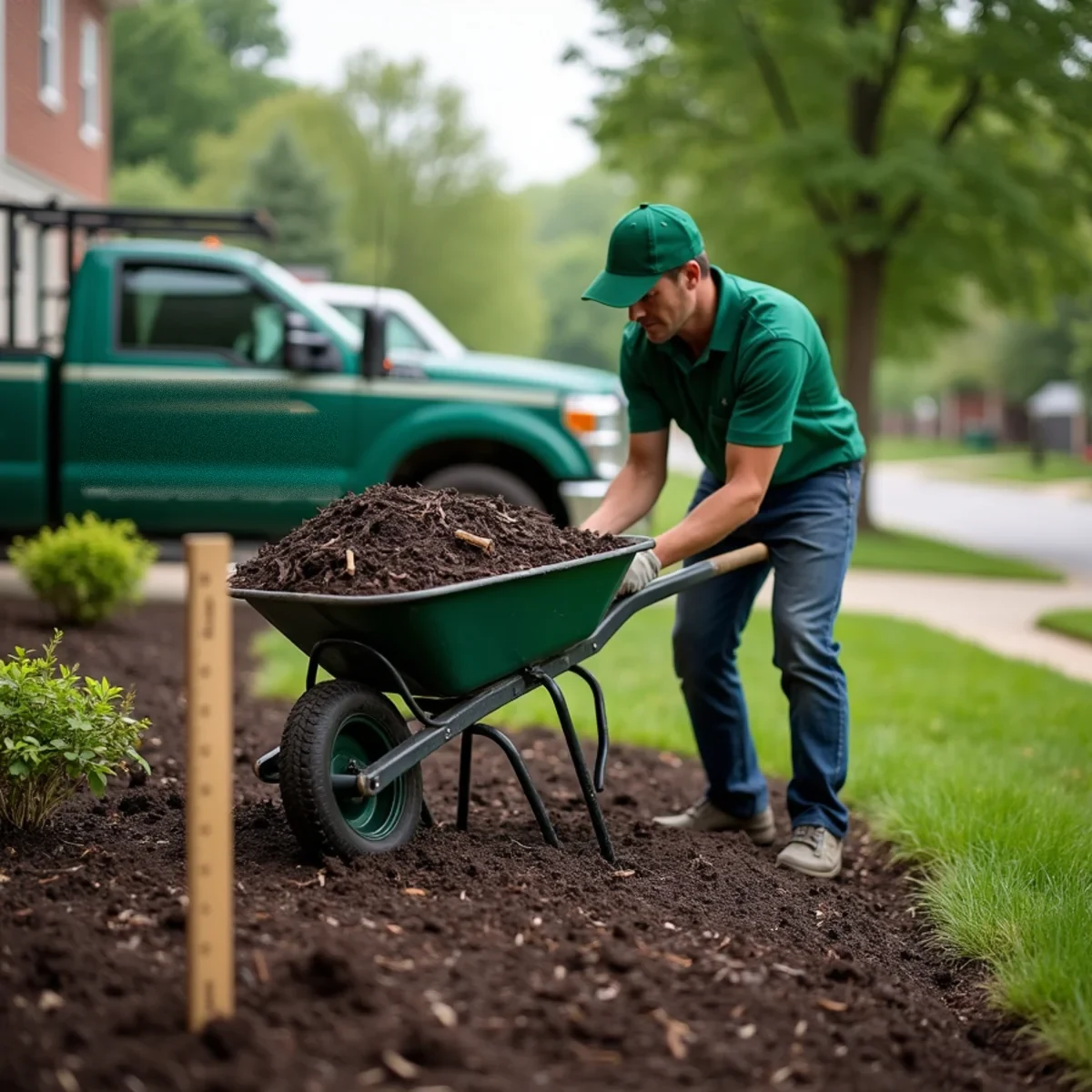
How much mulch do you need? Multiply the bed's square footage by the depth you want in inches, then divide by 324. The answer is in cubic yards. A 200 square foot bed at 3 inches deep needs about 1.85 cubic yards, or 25 of the common 2 cubic foot bags.
That formula covers most jobs, but the right depth, the right timing and where the mulch goes matter just as much as the amount. Below is the math with worked examples, a depth guide for new and existing beds, and the placement mistakes that hurt trees and houses. If you would rather skip the wheelbarrow, our mulching and bed maintenance service handles weeding, edging and mulch in one visit.
How Much Mulch Do I Need? The Formula
Bulk mulch is sold by the cubic yard. One cubic yard is 27 cubic feet, and that covers 324 square feet at 1 inch deep (27 × 12 = 324). That gives you the formula:
Cubic yards = square feet × depth in inches ÷ 324
For bagged mulch, the most common bag holds 2 cubic feet. One bag covers about 8 square feet at 3 inches, 12 square feet at 2 inches, or 24 square feet at 1 inch, and it takes 13.5 bags to equal one cubic yard. The bag shortcut: number of 2 cu ft bags = square feet × depth in inches ÷ 24.
Measuring Your Beds
- Rectangles and squares: length × width. A 20 by 10 foot bed is 200 square feet.
- Circles and tree rings: 3.14 × radius × radius. A ring 8 feet across has a 4 foot radius, or about 50 square feet.
- Curved or odd-shaped beds: break them into rough rectangles and circles, measure each piece, and add them up.
- Long, narrow strips: length × average width. A 60 foot foundation strip averaging 3 feet wide is 180 square feet.
Round your order up slightly. Mulch settles, bed edges are never perfectly straight, and it is easier to keep a few spare bags in the garage than to make a second trip.
Mulch Calculator Examples
Here is the formula at work on a few typical beds:
- 200 sq ft new bed at 3 inches: 200 × 3 ÷ 324 = 1.85 cubic yards, or 25 bags
- 180 sq ft foundation strip at 3 inches: 180 × 3 ÷ 324 = 1.67 cubic yards, or about 23 bags
- 400 sq ft of existing beds, 1 inch top-up: 400 × 1 ÷ 324 = 1.23 cubic yards, or about 17 bags
- 8 foot tree ring at 2 inches: 50 × 2 ÷ 324 = 0.31 cubic yards, or 4 to 5 bags
- 1,000 sq ft whole-yard refresh at 2 inches: 1,000 × 2 ÷ 324 = 6.17 cubic yards, or about 84 bags, which is a strong argument for bulk delivery
If you are hiring the work out, local planning benchmarks put mulch application around $0.34 per square foot, so the 400 square foot top-up above plans out to about $136. That is a rough planning range, not a quote. Our landscaping cost guide shows how mulch fits into larger project budgets.
How Deep Should Mulch Be?
For most beds, the target is 2 to 3 inches of total mulch. Less than that and weeds push through and the soil dries out quickly. More than that and water and air struggle to reach the roots, especially on Fort Wayne's dense clay, which already holds moisture.
- New beds or bare soil: spread 2 to 3 inches.
- Existing beds with old mulch: check before you buy. Push a trowel down and measure what is left. If there is still 1 to 2 inches, a 1 inch top-up is usually all you need.
- Around trees: 2 to 3 inches over the root zone, tapering to nothing a few inches from the trunk.
- Around city street trees in Fort Wayne: no more than 2 inches, as explained below.
The most common mistake is adding 2 or 3 fresh inches every spring on top of what is already there. After a few years the beds are 6 to 8 inches deep, the soil stays soggy, and shrubs start to struggle. Freshen the color with a thin layer, or rake the old mulch to loosen it, instead of piling on more.
Want your beds weeded, edged and mulched to the right depth without the wheelbarrow work? Call (323) 606-0255 for a free estimate.
Mulch Volcanoes and Other Placement Mistakes
A mulch volcano is the cone of mulch piled up against a tree trunk. Some people think it looks tidy, but it holds moisture against the bark, which can lead to rot and decay, gives rodents and insects cover, and can encourage roots to grow up into the mulch and circle the trunk. Pull mulch back so the base of the trunk and the root flare, where the trunk widens at the ground, are visible. Think donut, not volcano.
City of Fort Wayne Street Trees
If the tree you are mulching sits in the strip between the sidewalk and the street, it is likely city-owned. The City of Fort Wayne's Tree Protection Policy limits mulch over city tree roots to 2 inches and says no mulch should touch the trunk. The policy also bars compaction, excavation or added fill in a city tree's root zone without approval, so building a raised bed or piling topsoil around a street tree is off the table without the city's okay. Our post on Fort Wayne street tree rules covers who owns what.
Foundations and Siding
Keep wood mulch a few inches below siding and back from the foundation. Mulch piled against the house holds moisture against wood and gives insects a sheltered path up to the structure. After mulching, make sure the surface still slopes away from the house so water does not run back toward the basement.
Choosing a Mulch Type
- Shredded hardwood: the most common choice around here. It knits together, stays put on slopes and in heavy rain, and breaks down to feed the soil. It can mat if piled too thick.
- Dyed mulch: holds its color longer through the season. It is often made from recycled wood, so quality varies; buy from a supplier you trust.
- Pine bark: attractive and slow to break down. Larger nuggets are light and can float out of beds in heavy rain, which matters on flat clay lots where water sits.
- Cedar: aromatic and slow to decompose, so it lasts. It is light and can blow or wash around.
- Leaf mulch: free if you shred your own fall leaves, and an excellent soil builder. Shred it first, because whole leaves mat down and shed water. It breaks down fast, so expect to top it up more often.
- Rock: lasts for years and will not float away. But it does not feed the soil, holds heat around plants in summer, collects debris that weeds sprout in, and is a chore to remove if you change your mind. It works best in spots you do not plan to plant.
Best Time to Mulch in Indiana
For most beds, mid to late spring is the best time to mulch in Indiana, once the soil has warmed and dried out a bit. In Fort Wayne that usually means late April through May. Mulching too early insulates cold, wet ground and keeps it that way longer, which slows perennials and keeps clay soggy. Many homeowners pair mulch with a spring cleanup so beds are cleaned out, cut back and topped off in one pass.
Fall is the second window. A layer of mulch after the ground cools helps insulate the roots of new plantings and perennials through freeze-thaw cycles and reduces frost heaving. If you mulch in fall, keep to the same 2 to 3 inch total and skip the spring top-up if the beds are still deep enough.
Prep Before You Spread: Weed and Edge First
- Pull weeds by the roots, especially perennial weeds and grassy runners. Mulch slows new weeds from seed; it does not smother established ones.
- Cut a clean edge 2 to 3 inches deep along the lawn line with a flat spade or edger. A crisp edge keeps mulch in and grass out.
- Rake old mulch and break up any matted, crusty layer so water can soak through.
- Cut back perennials and clear leaves from the crowns of plants.
- Spread the new mulch by hand or with a rake, keeping it off stems, trunks and siding.
Landscape fabric under wood mulch is optional, and many crews skip it in planted beds. As mulch breaks down on top of the fabric, weeds root into that layer anyway, and the fabric makes it harder to add plants later.
Bulk vs. Bagged Mulch
Bagged mulch is convenient for small jobs, tree rings, and backyards you can only reach through a gate. It stores neatly and you buy exactly the count you calculated. Bulk mulch, delivered by the cubic yard, usually makes more sense once you need more than a couple of yards. It is typically cheaper per yard, but you need a spot to dump it, a tarp on the driveway, and time to move it before rain turns the pile into a soggy mess.
We weed, edge and mulch beds across Fort Wayne and the wooded lots around Leo-Cedarville, and we bring the right amount for your beds so nothing is left sitting in the driveway. If the beds themselves need rethinking, our landscape design and installation work can redesign and replant before the mulch goes down. Call (323) 606-0255 for a free estimate.
Need a hand with this?
Mulching & Bed Maintenance in Fort Wayne & Northeast Indiana
If you'd rather have it handled, our family-owned crew does this work every week. Estimates are free and written out.
Frequently Asked Questions
How many bags of mulch are in a cubic yard?
How much area does a cubic yard of mulch cover?
Should I remove old mulch before adding new mulch?
How long does mulch last?
Can I put mulch over weeds?
All About Tree & Turf Services
Family-owned landscaping and tree service in Fort Wayne, led by Darick Van. We share what we've learned working on real Northeast Indiana properties. Questions? Call (323) 606-0255.